Introducing Turbulence Realm: SINDy
May 30, 2025
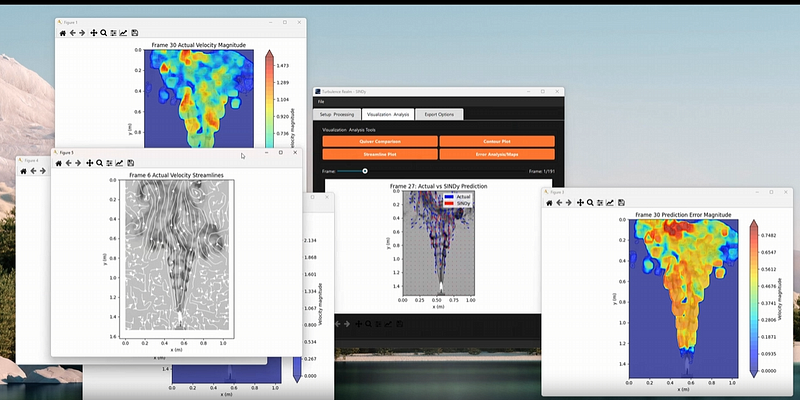
Most tools for analysing fluid flow stop at the picture. Turbulence Realm: SINDy (turbulencerealm.com) goes one step further: it watches a video of a flow, measures how the fluid moves, and then tries to write down the equations that explain it.
The desktop application joins two ideas. Computer vision, in the form of dense optical flow, turns video into a velocity field. Data-driven modelling, in the form of SINDy (the Sparse Identification of Nonlinear Dynamics, built on the pysindy library), turns that field into compact, readable equations that can predict what the flow will do next.
From video to equations
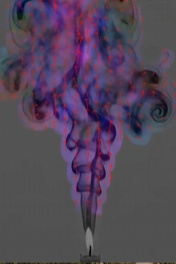
The journey begins with a video. The user loads it, draws a region of interest and calibrates the scale so that pixels become metres. The software then computes dense optical flow across every frame using the Gunnar Farnebäck algorithm, with optional blurring and denoising to calm the noise. On particle-laden flows, this approach has at times resolved the motion better than traditional particle image velocimetry.
Next comes discovery. SINDy searches the velocity data for the simplest set of differential equations that reproduces it, and once fitted, the model can predict future states of the flow. The application then lays the measured flow, the predicted flow and the difference between them side by side, as vector plots, contour maps and streamlines, with error measures for every frame and maps that show where the model struggles.
Finally, everything can leave the application: per-frame velocity data as CSV files for further analysis, and animations of the flow for presentations. Behind the scenes, memory-mapped files keep large videos and velocity datasets manageable on an ordinary computer.
A model that hands you an equation gives you a hypothesis you can test as well as a prediction.
Why equations beat black boxes
The point of SINDy is interpretability. A deep neural network may predict a flow accurately, but it will not tell you how it reached its answer. An explicit equation does: it shows which variables matter, how they relate and which forces are at work.
That makes the output scientifically useful in its own right. Each discovered equation is a candidate explanation, and researchers can design experiments to test its individual terms and coefficients. And because SINDy deliberately looks for sparse equations, the simplest model consistent with the data, the results are easier to analyse, easier to implement and far cheaper to compute than the black-box alternatives.