External Aerodynamics Is the Easy Part: Avoiding the Simulation-on-Simulation Trap
June 12, 2026
Modern design pipelines optimize external aerodynamics and structures with ML surrogates trained on CFD, simulations based on simulations. The visible layer is impressive work. But the difference between a great design and a great program lives below the waterline, in a century of flight and experimental test knowledge the industry has already paid for. The examples here are aerospace; the iceberg is universal to every complex engineered system.
A Familiar Pattern
A familiar pattern is emerging: a beautiful airframe rendering, a GPU solver or neural surrogate, an optimizer exploring "millions of designs." The demos are genuinely impressive, drag drops, L/D climbs, and a design loop that took weeks now takes minutes. But what is being optimized is external aerodynamics, structures, and shape, evaluated by a model, often trained on another model. Not where the fuel goes, how the engine breathes at 45,000 ft on a cold day, how the environmental control system routes high-pressure ducting through structure, or what the wing does aeroelastically at gauge thickness.
These disciplines are the most automatable precisely because they are the most mature and self-contained. That makes them the right place to start, and not, on their own, the reason a program succeeds.
Simulations Trained on Simulations
The technical issue is epistemic. RANS CFD, itself a model, generates a training database; a surrogate is fitted to it; an optimizer drives the surrogate into regions where it extrapolates. Every layer inherits the blind spots of the layer beneath it and adds its own.
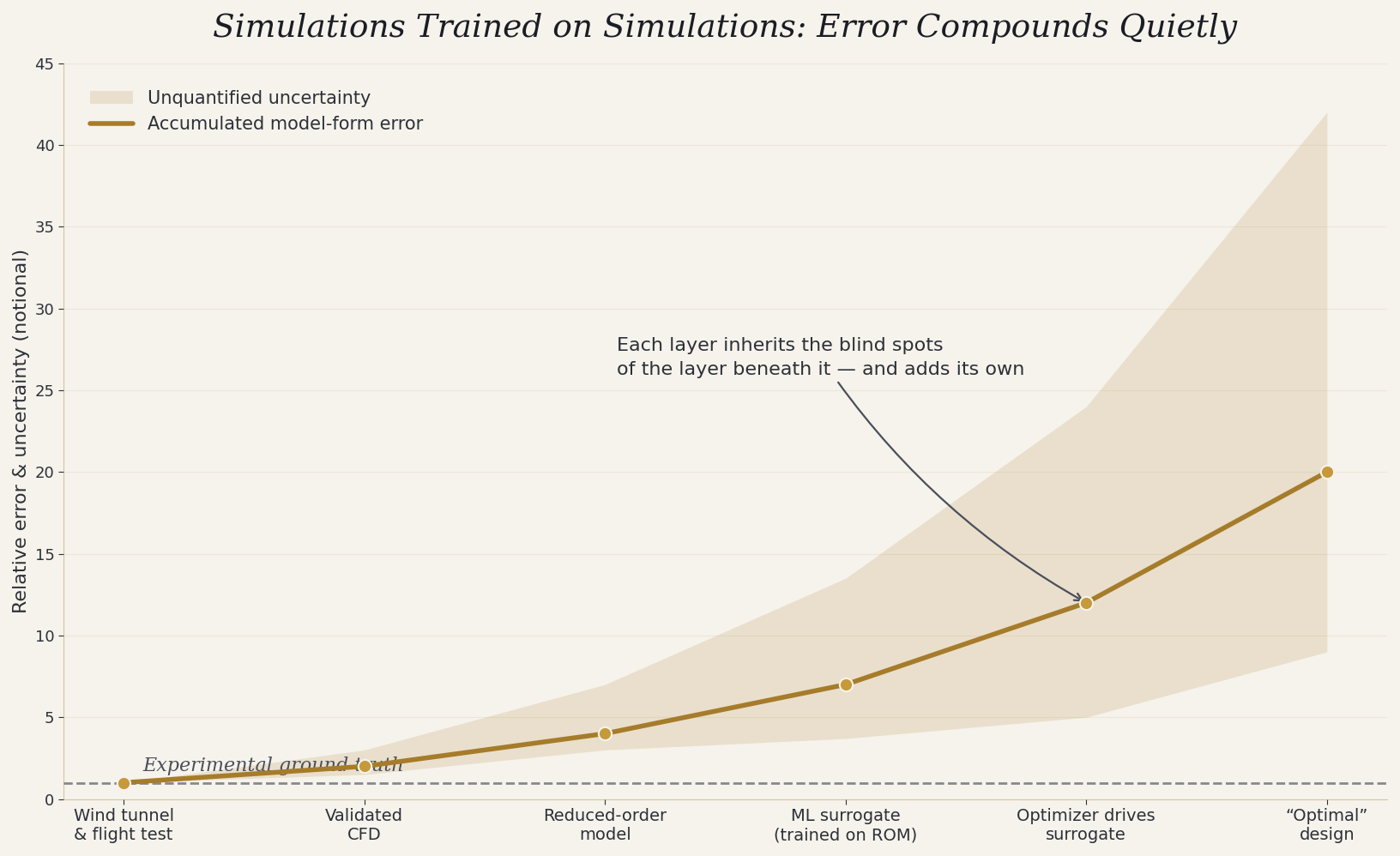
An optimizer is an adversary, not a colleague: it finds the regions where the surrogate's error is largest, because that is where the apparent "free performance" lives. The output looks optimal: it is optimal with respect to the error. Experienced design houses use RANS too, but inside a validation pyramid anchored by wind tunnel and flight test data. When the only ground truth in the loop is another simulation, "validated" quietly becomes "converged."
The Iceberg Below the Render
Even a perfect external optimization is a minority share of the engineering. The rendering sits on an iceberg of work that determines whether the product flies, keeps flying, and gets built at rate, and every item below the waterline is a solved problem somewhere in the industry. Swap the airframe for a turbine, a car, a ship, or a medical device, and the list barely changes.
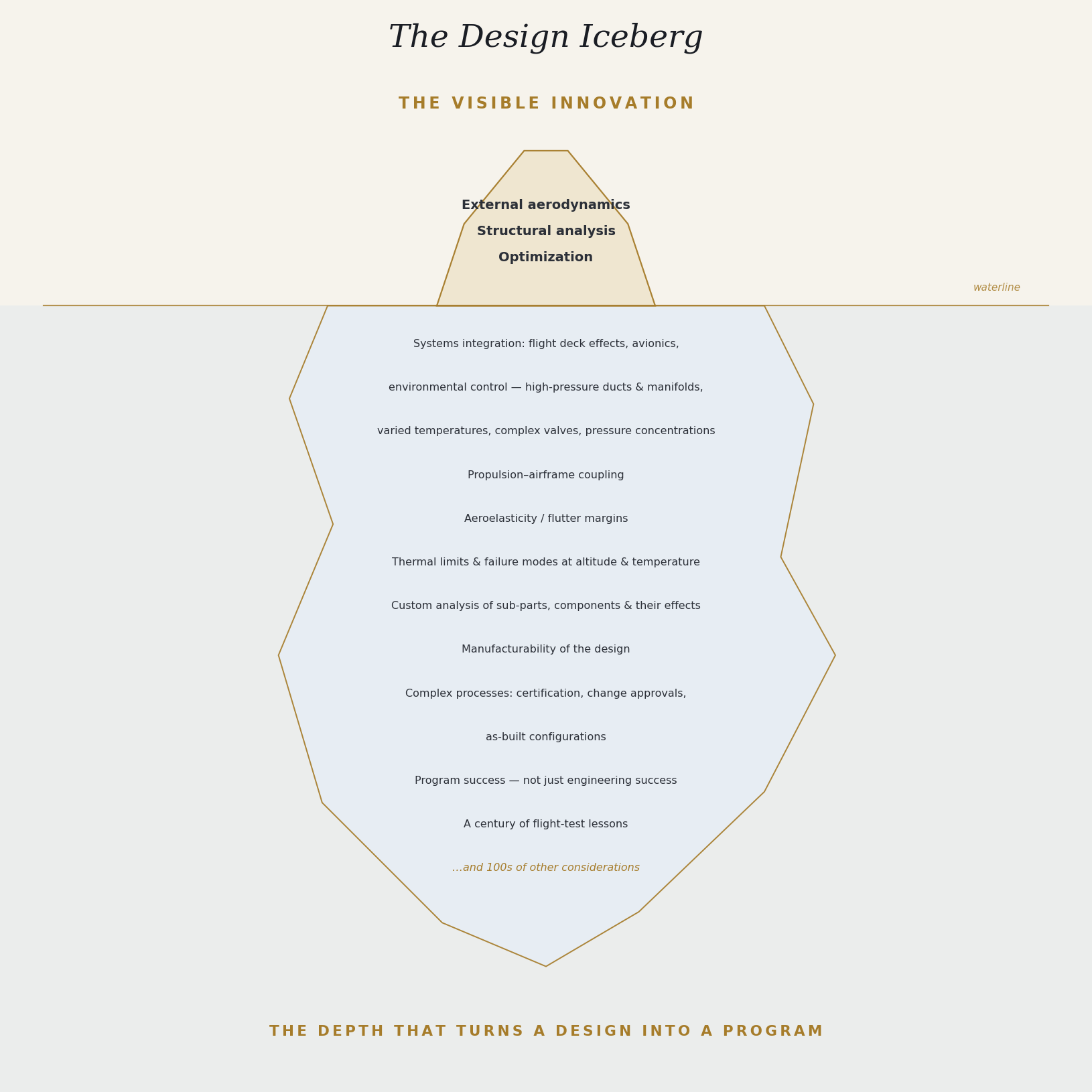
- Systems integration. Fuel volume, landing gear, flight deck effects, avionics cooling, and the environmental control system: high-pressure ducts and manifolds at widely varying temperatures, complex valves, pressure concentrations where ducts penetrate structure.
- Propulsion–airframe coupling. Inlet distortion at angle of attack, exhaust interactions, engine-bay thermal management, failure modes found in test cells, not drag runs.
- Aeroelasticity. The CAD surface is rigid; the built wing is not. Flutter, control reversal, and divergence depend on stiffness, mass, and temperature.
- Stability and handling qualities. A drag-minimal shape can have unacceptable pitch break or deep-stall behavior, judged against specifications written in flight test.
- Custom analysis of sub-parts and components. The wing-root fitting, the fastener pattern around a cutout, the bracket that changes a load path three frames away, each analyzed because each has mattered.
- Manufacturability. Can the loft be tooled, the spar laid up? Does the "optimal" panel cost ten times the drag count it saves?
- Complex processes. Certification, change approvals, and as-built configuration traceability, the machinery that keeps fleets safe for decades.
- Program success, not just engineering success. Weight, cost, schedule, supportability, and dispatch reliability close the business case.
- …and hundreds of other considerations, lightning strike, bird strike, fuel slosh, EMC, crashworthiness, each with its own library of hard-won lessons.
Where Vehicles Actually Fail: Altitude and Temperature
Vehicles are certified, and lost, at the corners of the envelope, not at the cruise point where every CFD render lives. Altitude and temperature shift nearly every margin at once, and comprehensive historical flight and experimental testing has already mapped what an external-flow pipeline cannot see:
- Engine relight limits, mapped by deliberately flaming out engines in flight test.
- Icing, leading edges reshaped into geometry no optimizer evaluated; probes and vanes lost with them.
- Hot-day, high-altitude lapse, the design that closes at ISA can fail to climb off a 45 °C runway at altitude.
- Thermal and cold soak, seals, lubricants, batteries, and dissimilar materials, qualified across −55 °C to +70 °C because each limit was once found the hard way.
A Century of Lessons Already Paid For
Every generation of engineers independently arrives at configurations that the tribal knowledge inside long-established design houses recognizes immediately, forward-swept wings, channel and ducted layouts, ultra-high-aspect-ratio wings. None are forbidden; several matured into successful aircraft, and a team with fresh tools may be the one that finally makes a shelved concept work. But only if it knows why the concept was shelved.
The lessons are documented, though not all in the open. The fundamentals live in the public literature: NACA and NASA reports, AGARD volumes, accident dockets. The deepest layers, flight test campaigns, qualification histories, design manuals refined over decades, are rightly protected as intellectual property and often controlled under export regulations such as ITAR. That protection reflects how valuable the knowledge is, and it is exactly why the engineers who carry it are such an asset. (Related: "Flaw in Stating Teams Are Using Outdated Tools", tools that look dated often embody validated physics.)
What Credible Looks Like
Fast surrogate-driven exploration is genuinely valuable, early, for trade studies, and as a complement to experiment. The credible version looks like:
- Anchor every model generation in experiment. A surrogate corrected by sparse experimental anchors beats one trained on an ocean of unvalidated CFD, the philosophy behind training PINNs on wind tunnel data.
- Carry uncertainty, not just point estimates. Constrain the search to trusted regions; flag excursions as test requirements, not results.
- Optimize the system, not the skin. A 2% drag gain that costs 8% fuel volume, or routes a bleed duct through a stress hot spot, is not a gain.
- Design for the program. Manufacturability, certification strategy, and as-built configuration management are design inputs, not paperwork that comes later.
- Buy the scar tissue. Study the public literature. The deepest knowledge is proprietary and ITAR-controlled for good reason, it cannot be downloaded, but it can be earned through experience, partnerships, and test programs of your own.
- Build and break hardware early. The wind tunnel, iron bird, and sub-scale demonstrator are where the simulation chain gets caught lying.
A healthy question for any workflow
"When did our toolchain last disagree with a physical test, and what did we change because of it?" A team with a ready answer is a team whose predictions can be trusted.
Conclusion
External aerodynamics, structures, and optimization are the photogenic 10% of an engineered product. The other 90% is where programs succeed, encoded in a century of test and field knowledge: the fundamentals in the open literature, the deepest layers rightly protected as IP and under export controls such as ITAR, living in established organizations and the engineers they trained. This is as true of turbines, vehicles, and ships as it is of aircraft. No one has to choose between speed and depth; the depth has already been paid for, and the door to it is the people who hold it. Pair a modern toolchain with a century of inherited judgment, and you get something neither could deliver alone. Speed is a feature. Validation is the product.